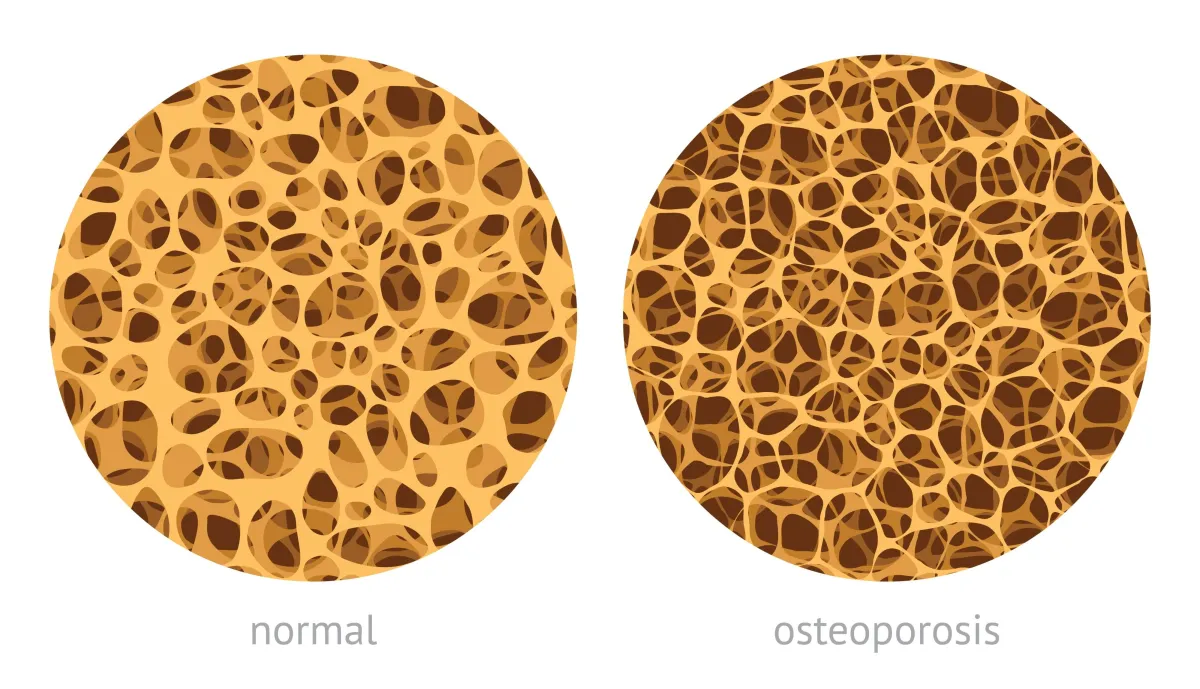
The Osteoporosis Advice That Makes Bones Weaker
"If you have osteoporosis, avoid heavy lifting. Be careful. Stick to walking and light weights...."
The problem with that line of thinking is that your bones aren't fine china. They're living tissue that responds to the demands you place on them.
Tell them "nothing heavy coming your way," and they respond by getting weaker.
The Landmark LIFTMOR Study
The LIFTMOR trial asked a question most researchers were too cautious to consider: "What if women with osteoporosis lifted REALLY heavy weights?"
The study enrolled 101 postmenopausal women with low bone mass (some with full osteoporosis) and split them into two groups.
One did supervised high-intensity training—5 sets of 5 reps at 85% of their one-rep max on deadlifts, overhead presses, and back squats, plus jumping chin-ups with hard landings.
The control group did light home exercise with hand weights up to 3 kg.
Both trained 30 minutes, twice weekly, for eight months.
Guess What Happened?
The heavy-lifting group increased lumbar spine bone density by 2.9%. The control group LOST 1.2%.
Only 18.6% of heavy lifters lost any spine bone density, compared to 72.1% in the control group.
Density is only part of the story.
Femoral neck cortical thickness—the part that actually prevents hip fractures—increased by 13.6% in the heavy lifting group. Cortical bone contributes over 90% of hip compressive strength.
Leg strength increased 37.1%. Back extensor strength improved 36%. The timed up-and-go test (a fall risk predictor) improved by 4.3% while the control group got 2.2% SLOWER.
The heavy lifting group got TALLER—gaining 0.2 cm while controls lost 0.2 cm.
Is This Heavy Lifting Safe?
With over 2,600 supervised sessions, there was ONE adverse event, a minor back spasm that caused someone to miss 2 sessions. No fractures. No serious injuries. 92% compliance rate.
Why Heavy Loading Works
Bone adapts to high-magnitude strain applied at high rates.
When you lift heavy, your muscles contract forcefully and transmit that load to your skeleton. Your bones “feel” that stress and signal osteoblasts to build more tissue.
Bones only respond to loads significantly higher than what they're used to.
That 3# hand weight? Your skeleton yawns at it.
A deadlift at 85% of your max? NOW your bones pay attention.
The jumping component adds high-rate loading.
Ground reaction forces shooting through your skeleton fast create the strain bone tissue needs to adapt.
Got Low Bone Mass?
Get proper screening. LIFTMOR participants went through rigorous medical screening.
Start with progressive loading. The protocol began with a full month of bodyweight and low-load movements before advancing.
Prioritize compound, weight-bearing lifts. Squats, deadlifts, and overhead presses load the skeleton globally. Machines don’t provide the same stimulus.
Train heavy but smart. Around 5×5 at 80–85% of your 1 rep max is heavy enough to stimulate bone while allowing good technique.
Include impact loading when appropriate. If jumping isn’t suitable, step-downs or forceful foot strikes can provide similar stimulus.
Train twice per week. Just 60 minutes total per week produced these results.
Supervision is mandatory. Every session was professionally supervised. This isn't a DIY protocol.
We've been so afraid of breaking fragile bones that we've prescribed interventions that make bones MORE fragile!
The LIFTMOR trial proved that properly supervised high-intensity resistance training isn't just safe for people with low bone mass, it's effective--and light exercise does virtually nothing!
