It's Not What You Eat. It's What's Eating You.
A client sat down with me last week and asked me to give her a diet.
She’d lost weight before — more than once, actually. Each time, it came back. She described a plan that worked previously— but she wasn’t prepared to live on that diet.
That’s just one reason diets don’t work.
There’s so much truth in the saying, “Keep doing what you’re doing and you’ll keep getting what you’re getting.”
The habits that caused weight gain will cause that weight loss to come roaring back, bringing even more pounds with it, if you didn’t do strength training to preserve your muscle.
Instead of “being on a diet” to lose weight, think of that weight loss period as a college course in healthy eating. It’s an education that results in becoming healthier, increasing your ability to feel good, and reducing the risk of disease. It’s important to learn those lessons!
The longer we talked, the more I thought that “a diet” wasn’t going to be the answer for her. There were lifestyle, behavioral, and emotional issues at play that are typical for people in search of weight loss.
Later, I remembered something I read a long time ago, when I was dealing with my own food issues:
It’s not what you’re eating. It’s what’s eating you.
Rather than jump headfirst into a diet plan, the best thing to do is take some time to think about the journey that’s brought you to where you are today.
My mom was significantly obese for most of the years I was growing up. One day, in her later years, she commented, “I don’t know how I put on all that weight. I think maybe it was the stress from teaching school....” It was like she was looking back at someone she used to know.
It’s not at all unusual to self-medicate with food. As I learned from a book called Overcoming Overeating, we first need to give ourselves credit for doing the best we could to take care of ourselves in stressful times. Once we accept that, we can finally start finding more effective, beneficial ways to do it.
A More Practical Approach
While you're working on the emotional "why" of weight gain, you still have to navigate the physical "how" of daily eating. And that’s where the "eat less" advice completely fails us.
By adulthood, you’ve eaten tens of thousands of meals, and your brain has a sense of how much food should be on a plate. When a restrictive diet cuts that volume dramatically, you start feeling deprived.
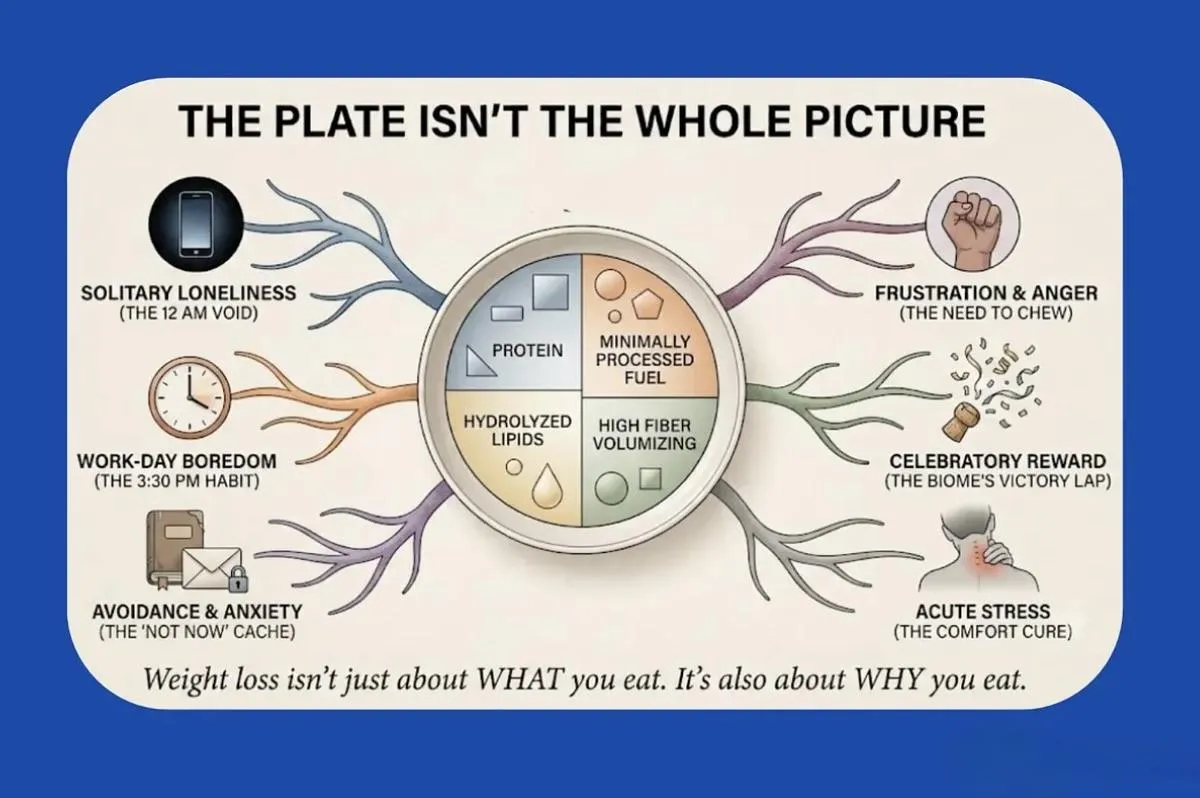
Weight management isn’t just about how much you eat, but about the structure of what’s on your plate.
A 2020 review found high-protein eating patterns to be an effective tool for weight loss and, maybe more importantly, for preventing the weight regain that trips up so many people. Protein appears to boost the hormones responsible for feeling full, while suppressing ghrelin, the hormone that drives hunger in the first place.
Fiber works a different angle: it adds bulk to meals and slows digestion, so fullness lasts longer. A 2013 review linked higher fiber intake to lower body weight overall.
A 2025 study found that people who ate mostly whole, minimally processed foods could eat a larger volume of food while taking in fewer calories than people eating a more processed diet. Soups, fruits, vegetables, beans, yogurt, and oats all have high water or fiber content, which means more food, weight-for-weight, at a fraction of the calorie cost of foods like chips, ultra-processed foods, or baked goods.
Put those together, and you get a simple principle: meals built around protein, fiber, and minimally processed foods are naturally more filling, saving you from feeling deprived, a.k.a. “like you’re on a diet.”
It’s Not Just About the Food
One reason weight loss programs don’t create lasting success is that the focus is on food. Long-term weight loss is more than counting calories....or macros....or carbs.......
Weight loss is harder:
if you’re stressed.
if you’re not getting quality sleep.
if you’re sedentary.
if you eat fast or distracted.
if the focus is on what you “can’t have.”
if you follow a restrictive diet.
if your mind isn’t in the right place.
Restrictive dieting with the goal of quick weight loss can lead to lasting changes that may slow your metabolism, alter hormones that regulate hunger, increase stress hormones (which promote fat storage), and interfere with efforts to maintain your weight.
A weight-reduced body responds differently to food and exercise than a body that hasn’t dieted, and a dieter’s muscles may burn fewer calories than expected during exercise. Chronic dieters may be eating far fewer calories than those around them, but still aren’t losing weight.
Back to My Client
What she needed wasn’t another version of the diets she’d already tried. She just needs time to process how she uses food (comfort? entertainment? boredom?), habits that facilitate overeating (eating out? eating in front of the TV? eating fast or mindlessly?) and a way of eating she could sustain without white-knuckling it — one that keeps her satisfied, works with how her body’ hunger and satiety signals, and doesn’t depend on rules she’ll eventually stop following.
That’s the piece “eat less” advice always misses. The goal isn’t just to lose weight, it’s to build eating habits you’re happy to live with while still enjoying food, because that’s important, too.
Interestingly, I've also noticed something in all these decades of working with people: those who treat strength training as a practice — something you return to, not something you finish — tend to maintain a practice of eating well too.
One habit supports the other.
This Is Why I Created the ELEVATE Program
I dreamed of creating a program that would address more than counting calories--focusing on adding, rather than subtracting, practicing mindful eating habits, and creating a way of living.
ELEVATEisa 16-weekholistic approach that looks beyond food, encompassing mindful eating, getting enough sleep, managing stress, choosing nutritious foods, and moving more, in addition to prioritizing strength training.
The program focuses on a different habit for 2 weeks in daily lessons and tasks, all delivered on our app—so you can do it from anywhere! There’s also a workbook to help you process how your days and weeks go.
If you’d like to learn more, reach out to [email protected]
You don’t need another diet. You need a plate that’s working with you instead of against you and habits sturdy enough to survive the parts of life a meal plan can’t control.
