The Exercise You May Be Avoiding Without Realizing It
Through the years, I’ve worked with many people whose lower-body strength was significantly lower than average.
When asked, "Do you live in a house with stairs?" universally, the response was (a rather proud) "No, my house is all one level!"
That's a missed opportunity for impactful exercise.
In the world’s so-called Blue Zones—places like Sardinia, Okinawa, and Ikaria, people regularly live into their 90s and beyond.
They're not following workout plans.
They’re walking on uneven terrain. They’re climbing hills and navigating stairs daily.
In Sardinia, researchers found that terrain slope and daily elevation gain were strongly linked to longevity. In some regions, the typical pattern of men dying earlier than women was virtually absent.
It wasn't all due toexercise. It waslife.
The definition of "exercise" is changing
Public health guidance is catching up to this idea.
The message is shifting from long, structured workouts toward something simpler: all movement counts, especially short bursts of meaningful effort throughout the day.
Just 4 minutes a day of vigorous movement, often broken into 30–45 second bouts, is linked to dramatic reductions in all-cause mortality,especiallyin people who don’t otherwise “exercise.”
It may not burn many calories (most exercise doesn’t), but it appears to extend your health span--a 44% drop in deaths, according to one study.
The biggest benefits come from moderate to vigorous movement.
One minute of incidental vigorous activity prevents premature deaths, heart attacks or strokes as well as about 3 minutes of moderate activity or 35 to 49 minutes of light activity.
Use your breathing as a guide: If you can sing, it’s light intensity. If you can speak but not sing, you’re entering moderate exertion. If you can’t hold a conversation, it’s vigorous.
Researchers call this VILPA: vigorous intermittent lifestyle physical activity.
Stairs, it turns out, might be the MVP.
Studies have shown that climbing just 50 stairs daily reduces the risk of stroke, blood clots, and heart attacks by as much as 20%.
These benefits accrued with five flights of stairs a day, compared to people who did not climb any stairs daily.
Climbing stairs gives you 3 times as much exercise as the same amount of time walking on the ground.
When you climb stairs, your body does a lot all at once.
You balance on one leg. You lift your body weight against gravity. Your heart rate jumps. Your nervous system has to coordinate force, timing, and stability with every step.
On the way down, you load your muscles and bones eccentrically--the kind of stress that helps maintain strength and bone density as we age.
If you rarely climb stairs or it’s not safe to climb unassisted, check with your doctor before starting any activity regimen.
Make sure the handrail is well within reach!
Modern life keeps erasing natural resistance. Elevators, cars, delivery services, desk jobs....it’s a frictionless world.
But the stairs are still there.
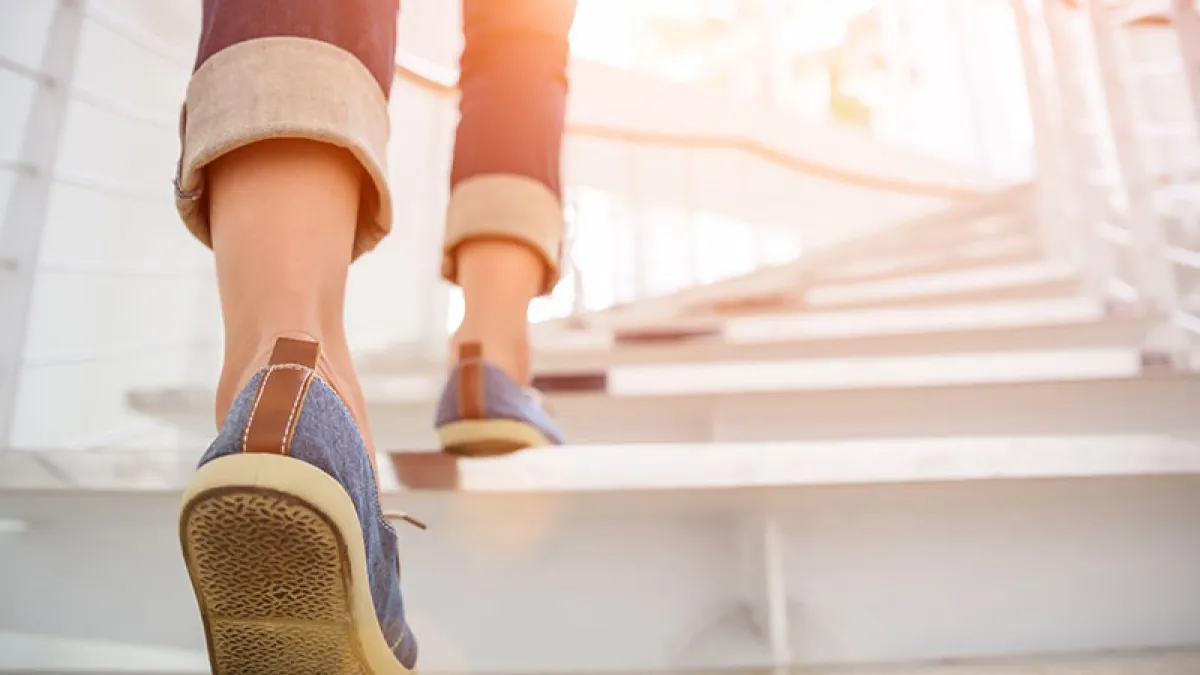
Weave exercise into your day. Take the stairs. Let gravity provide some of the work.
Since we can’t all move to Sardinia, we can stop avoiding gravity instead!
