It Improved My Bone Density—Something I Didn't See Coming
"You have osteopenia!" (insert dramatic music....)
I thought the doctor was being overly dramatic 2 years ago when she delivered the results of my bone density test.
I was nonplussed.
I've been hearing that for 20 years and stopped worrying about it when the former head of the osteoporosis clinic assured me, "You probably never had more bone than that to begin with."
This time felt like an intervention, and osteoporosis drugs were suggested.
After comparing my DEXA scans, I discovered there was no net difference from one test to the next, so I let it go.
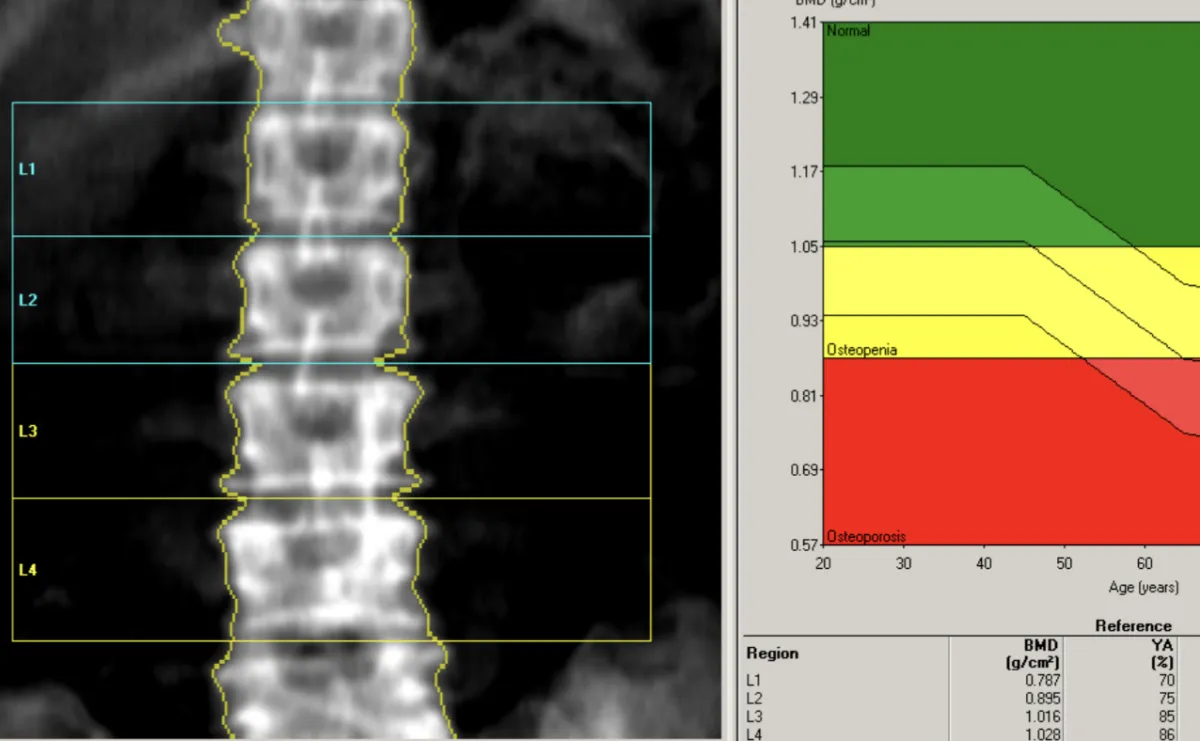
Two weeks ago, I had another DEXA scan. To my surprise, I saw
my spine bone density increased by 5.2%, now almost normal, up 5.2% in 2 years.
my 10-year hip fracture risk dropped—from 16% to 15% on the left, and from 16% to 14% on the right.
What changed in those 2 years? Just one thing.
About a year ago I started taking creatine and noticed that I was lifting much heavier weights.
I thought of this landmark study of women with low bone mass, some with osteoporosis.
Participants were split into 2 groups:
The high-intensity groupdid 5 sets of 5 reps at ~85% of one-rep max on deadlifts, back squats, and overhead presses, plus jumping chin-ups with firm landings.
The control group did a light, home-based exercise program using hand weights up to 3 kg.
Both groups trained twice per week for 30 minutes, over 8 months.
And....
🦴 The heavy lifting group increased lumbar spine bone density by 2.9%. The control group lost 1.2%.
🦴 Only 18.6% of the heavy lifters lost any spine bone density, compared to 72.1% in the control group.
🦴Femoral neck cortical thickness (a frequent fracture site) increased by 13.6% in the heavy lifting group. Their leg strength improved by 37.1% and back extensor strength increased by 36%
🦴 The timed up-and-go test (a fall-risk measurement) improved by 4.3%. The control group got slower.
🦴 The lifting group got 0.2 cm taller. Controls lost the same amount.
In over 2,600 supervised training sessions, there was ONE minor incident—a temporary back spasm that caused someone to miss 2 sessions.
Thanks to the creatine, I am lifting more weight. To be clear: creatine isn’t a bone-building shortcut.
The benefit came from lifting heavier, more consistently. Creatine made that possible.
That explains why walking doesn't improve bone density
If it did, people who walk for exercise would have great bone density.
Bones only respond to meaningfully higher loads than what they’re accustomed to.
If you have low bone mass:
Get proper medical screening. Study participants were cleared before starting.
Progress gradually.The protocol began with a month of bodyweight and low-load movements before advancing.
Prioritize compound lifts.Squats, deadlifts, and overhead presses load the skeleton globally, something machines don’t do.
Train heavy but smart(er). 😉 Good technique is essential.
Include impact loading when appropriate. If jumping isn’t suitable, step-downs or forceful foot strikes can provide similar stimulus.
Train twice per week. Just 60 minutes per week drove these changes.
Get professional supervision. This was not a DIY program.
Your bones aren’t fine china.
They’re living tissue that adapts to the demands you place on them!
