The Most Prevalent Causes of Knee Pain Aren't in Your Knee
I’d seen that look many times before: wary, uneasy, maybe even scared.
This new client wasn’t a veteran exerciser but more than that, she had a painful knee and couldn’t imagine that starting an exercise program wouldn’t make it worse.
Fast forward just a few months…..she is doing everything in her workouts, including power training!
Another client who had intermittent knee pain she couldn’t explain says it’s gone.
In one case, a man who’d had a knee replacement came to one of our clinics and told us that he’d had a knee replacement and was scheduling that surgery for the other one. He decided to join TrainSmarter and not only is that knee doing great, he’s deadlifting impressive weight!
The other day, it occurred to me that we’ve had loads of people come through our door with knee pain that we’ve been able to alleviate.
In light of the success we’ve had, I thought I’d devote this month to dealing with knee issues.
One of the most common sources of knee pain is osteoarthritis.
People with knee osteoarthritis often have pain that interferes with their ability to get up and down and climb stairs.
My mom’s knee arthritis dictated her life. Every time we talked about going somewhere, her first question was, “Are there stairs?”
You can’t always predict knee pain based on an x-ray. Some people have wretched-looking x-rays and feel no pain. I was told in my 30s that I had some degeneration in my left knee. That was decades ago, and that knee feels fine.
Because osteoarthritis predominately affects older people, doctors seem to be quick to jump to the conclusion that if you’re of a certain age, that knee pain is arthritis.
Or as an orthopedist told one of our clients, the cause of her knee pain was “too many birthdays…”
Because X-rays don’t correlate with the level of pain or disability someone experiences, let’s agree to eliminate this phrase:
“bone on bone”
Time after time, a client has said, “I got my knee checked out and doctor says it’s bone-on-bone.”Usually accompanied by a gesture of one hand smashing into the other…..
I wish I could count how many people have said that and gone on to have no knee pain. One client had already had a knee replacement and the other knee was….well, you know….. but after starting a strength training program, she’s not only able to doeverythingin her workouts, she’s leading a supremely active life, hiking, doing home renovations, and running her business.
The unfortunate part is….
A client in her 80s told me today that no doctor had ever recommended that she exercise for her arthritis. In fact, she just started exercising for the first time in her life.
By far, the most common causes of knee pain in our experience have been related to how people move and muscle imbalances.
That makes the right kind of exercise the perfect intervention.
People get painful knees because of
the way they walk
the position they hold their pelvis
shoving weight into their knees when they stand, go up stairs, and exercise
weak hips that don’t keep the knees properly aligned.
Know what I haven’t seen cause knee pain in my 40 years of experience?
Weak quads.
Yet when you look up information on managing knee pain, you’re covered up in articles about how to strengthen your quads.
Know what muscle weakness overwhelmingly causes knee pain?
Weak hips.
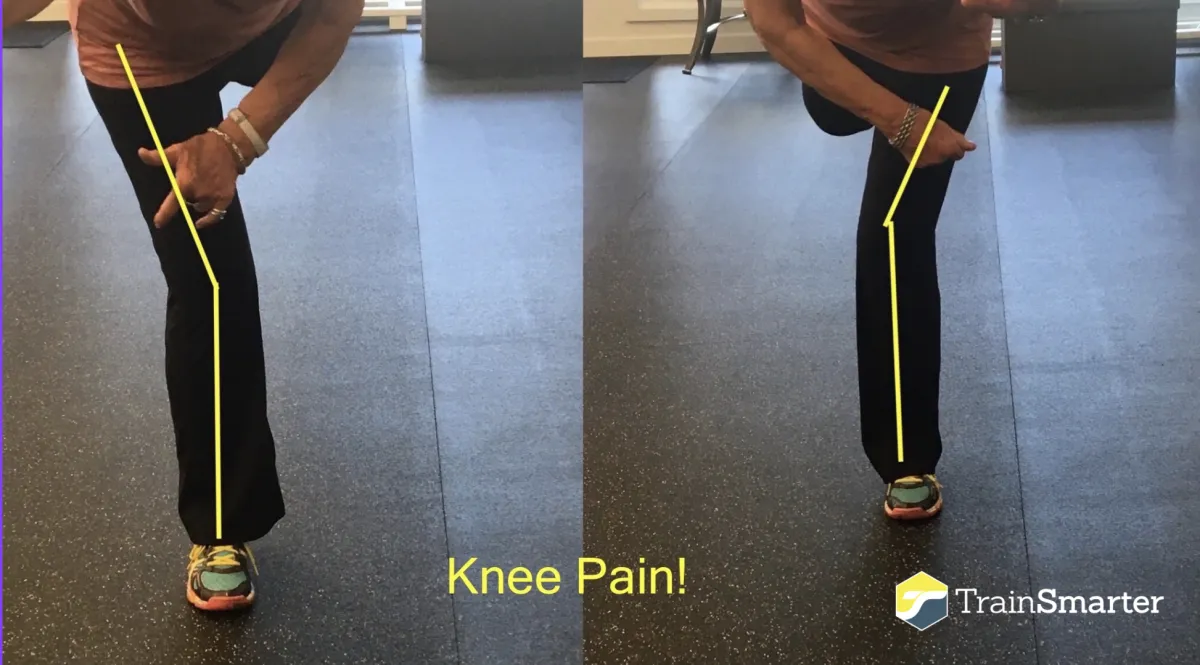
Knees only move in one direction. The hips control which direction the knees point. So if the hips are weak and the knees collapse inward (most often women) or rotate outward (most often men), the knees take a beating.
The pressure becomes more intense the more you bend your knees, particularly when you’re going up stairs or squatting.
Like a LOT of other issues regarding the body, just because the knee hurts, it doesn’t mean that the knee is the problem.
It’s the victim, not the perpetrator.
The secret to our success…
We approach knee pain and prevent its occurrence in our clients by
evaluating gait mechanics and teaching a mid-foot strike
teaching people how to recruit their glutes, rather than their quads
strengthening the hips, particularly the deep rotators
training people how to move so that they don’t shove their femur into the knee joint, particularly when going up stairs.
Exercise is safer and more effective for managing osteoarthritis than standard pain medications. It can delay or completely eliminate the need for surgery.
Every person I mentioned at the start of this piece walked in convinced their knee was too far gone. “Bone on bone” meant the knee could only get worse. They needed someone to look past the knee and find out what their hips and everyday movements were doing.
I’m hoping I can spare someone unnecessary pain or surgery. Joint replacement should be a last resort.
