When Clients Tell Me They Have Bad Balance, This Is What's Really Going On
Try this right now.
Stand on one foot. Not too hard, right?
Now close your eyes.
If your body immediately began to sway, your arms flew out for support, or you had to drop your foot within three seconds, you just met your vestibular system — and it may have some catching up to do.
One of the most common things I hear from new clients is “I have bad balance.” It’s almost always said with a mix of resignation and embarrassment, as if it’s simply an inevitable part of getting older.
It’s not. But it is more complicated than most people realize.
Balance Is Never Just One Thing
Over the years I’ve worked with hundreds of people who came to us with balance concerns.
Some had weak hips and legs. Strength training fixed that relatively quickly. Some had faulty posture and gait mechanics. Some had simply forgotten how to use their toes to catch themselves when they started to tip. Some needed different footwear.
(I’m looking at you, Hokas.... )
Some needed all of the above.
The one constant? Fear. Almost everyone who struggles with balance is also afraid of falling. That fear, as understandable as it is, makes the problem worse. When you move tentatively, you deprive your body of the practice it needs to stay steady.
To conquer that fear, we have to understand that balance is the product of coordinating three distinct internal systems.
The Three Pillars of Balance
1. Strength and proprioception: This consists of your muscles, joints, and the nerve endings that tell your brain where your body is in space. This is what most people think of when they think about balance training — single leg exercises and stability work. People often know how to train their major skeletal muscles but neglect their smaller stabilizer muscles--and they’re critical!
2. Vision: Your eyes are constantly feeding your brain information about where you are relative to your environment. This is why balance gets harder in the dark, or why older adults sometimes struggle on uneven terrain where visual cues are confusing.
3. The vestibular system: The fluid-filled canals in your inner ear that detect head movement and orientation, act like your body’s internal gyroscope. This is the system most people are most unfamiliar with, and the one most balance programs neglect.
Your brain constantly cross-references these three signals. If you step on an uneven patch of grass, your ankles signal the shift, your eyes spot the dip, and your inner ear tracks the tilt of your head. Your nervous system fires a split-second correction to your muscles, and you stay on your feet.
When all three systems are working well and communicating with each other, you stay upright effortlessly. When one of them degrades, your fall risk goes up significantly.
The vestibular system tends to erode with age. Research shows that over a third of adults over 40 already show signs of vestibular dysfunction. Those with clinically significant dysfunction had a 12-fold increase in the odds of falling.
Meanwhile, the CDC reports that falls are the leading cause of fatal and nonfatal injuries in older adults, with the rate of deaths climbing 21% between 2018 and 2024.
The good news is that just like a weak muscle, the vestibular system is trainable. If you give it the right stimulus, it can adapt, sharpen, and rebuild its connection to your eyes and joints.
Why Generic Workouts Leave You Vulnerable
If you’re just walking on a treadmill or sitting at traditional weight machines, you aren’t training your balance.
A 2024 review looked closely at how different types of exercise affect our stability. The researchers discovered that traditional, static gym routines didn’t do much at all for inner-ear coordination.
Instead,functional movement patterns—dynamic exercises like lunges, single-leg deadlifts, and multi-directional carries—improved vestibular outcomes to a significantly higher degree.
Functional movement forces your head to move through space while your feet are interacting with the ground, triggering that three-way neural conversation.
There’s also power in directly forcing the inner ear to work without its favorite crutch: your eyes. A 2015 experiment split women aged 60 to 76 into two training groups. One group did standard fitness exercises, while the other performed a specialized vestibular-stimulating program involving specific head and body movements.
The vestibular group showed dramatic improvements in postural stability with theireyes closed. Traditional training simply couldn’t replicate the effect. When you close your eyes, you strip away the visual cheat-code, forcing your brain to rely entirely on the inner ear’s signals. If you haven’t trained that pathway, your balance collapses.
Why We Taught Juggling
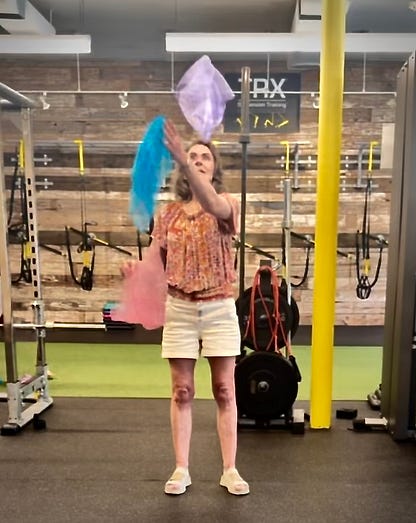
If you attended our Learn to Juggle Workshop last month, you experienced vestibular training firsthand — you just might not have known it!
Juggling requires your eyes and your inner ear to work together in real time, tracking moving objects while your head shifts position. It’s exactly the kind of multi-system challenge that keeps your balance sharp.
We weren’t just having fun. We were training your brain. 🤹
Four Exercises to Start Today
You don’t need special equipment to start stimulating this system. Add these simple drills to your existing routine:
Gaze stabilization drills.Hold your thumb or a small object at arm’s length. Move your head side-to-side, then up-and-down, while keeping your eyes locked onto the target in sharp focus. Start slow and build speed over several weeks.
Head turns during cardio.While walking on a treadmill or outside, turn your head to look left and right at a steady rhythm every few paces. Be careful and start slow. This can feel disorienting at first.
Eyes-closed single-leg stance.Stand near a wall or a sturdy counter for safety. Stand on one leg, close your eyes, and hold for up to 30 seconds. This forces your brain to rely entirely on vestibular input with no visual backup. Notice how quickly your ankles have to fire when your eyes aren’t helping.
Daily neck mobility work.Ear-to-shoulder holds and circular rotations keep your neck mobile. A stiff neck restricts the movement signals your inner ear needs to stay calibrated.
Conquering The Fear Factor
The fear of falling is real, valid, and incredibly common. But fear leads to reduced movement, and reduced movement leads to exactly the kind of deconditioning that makes falls more likely.
The antidote isn’t willpower. It’s building competence — strength, coordination, and balance confidence — so the fear has less to feed on.
Falling isn’t inevitable. And neither is the fear of it!
