Tick Season Is Here. What You Need to Know.
A client recently showed me a tick bite she'd gotten while hunting Easter eggs with her grandkids. (That little sucker--see what I did there?--left a mark!)
She asked me to write about what you should watch for, and what to do if you find one on you.
I've heard more tick warnings this year than usual. Emergency room visits for tick bites this April were higher than any April since 2017.
Warming temperatures and changing land use are pushing tick species into areas where people haven't had to think about them before.
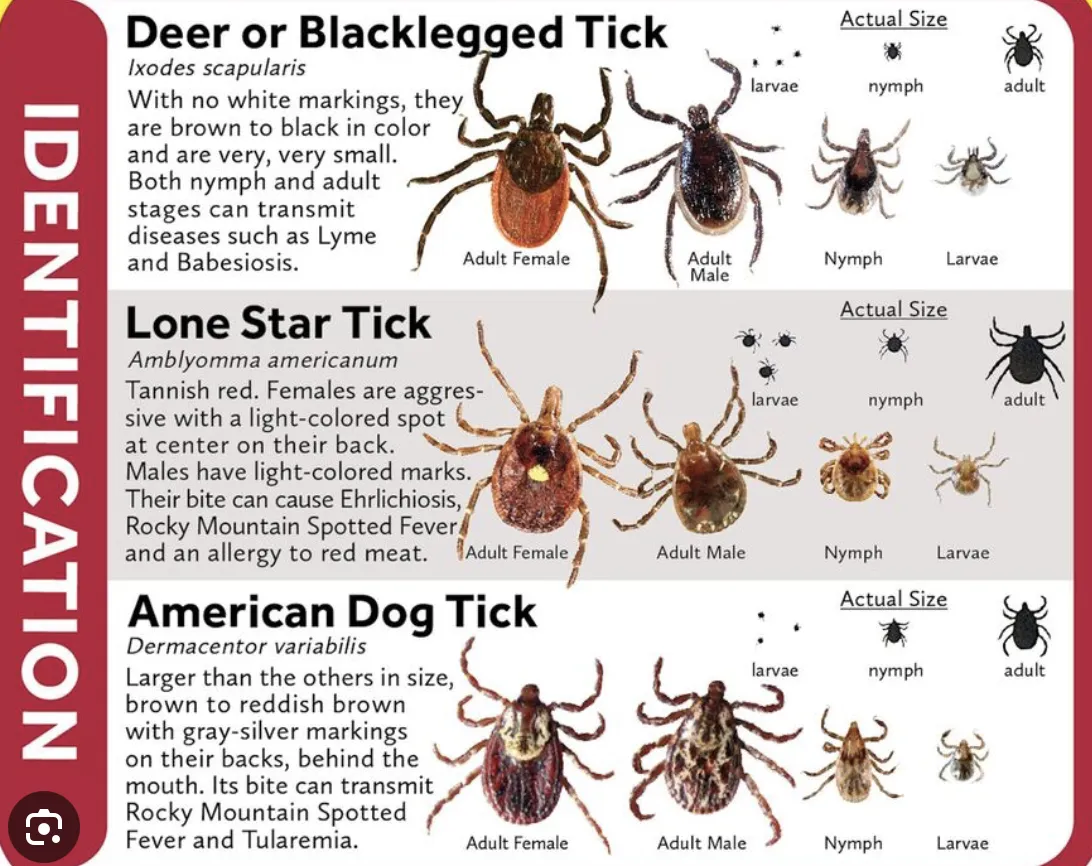
Blacklegged ticks, known as deer ticks and the ones that carry Lyme disease, have been common in the Northeast and Upper Midwest. They're spreading further north every year and showing up more often in Southern states.
Asian longhorned ticks, an invasive species first identified in New Jersey in 2017, has spread fast and now been found in states as far apart as Oklahoma and Connecticut.
Gulf Coast ticks, once confined to the coast, have moved inland and are now as far north as Ohio, carrying Rickettsia (a spotted fever relative).
Lone star ticks, once mostly a Southern problem, are now common as far north as Long Island and Martha's Vineyard. Their bites can trigger alpha-gal syndrome, along with bacterial and viral infections.
A note on Alpha-gal....
I know at least 2 people who have it so it's not as rare as you might think!
It's an allergy to a sugar molecule found in all mammals. This means no beef, pork, lamb, or venison. It can extend to dairy, gelatin, lanolin, wool, and foods prepared with mammal products.
The scary thing is that people have died from the allergic reaction. Because it usually occurs 3 to 6 hours after eating, the association isn't made.
People often wake up in the middle of the night with hives, stomach cramps, or trouble breathing, and have no idea it was the hamburger they had for dinner.
Many people have it for years before they realize it's not just "random" stomach issues or recurring hives.
👉 Learn what it’s like to live with AGS here.
A Tick Can Carry More Than One Disease
The number of tick nymphs carrying both the bacteria for Lyme disease and the parasite for Babesiosis (a malaria-like infection) has tripled in some areas over the last decade.
Researchers found other combinations, but this one alarms experts most because babesiosis doesn't respond to the standard Lyme antibiotic. It requires a two-drug treatment.
Undiagnosed, it can damage red blood cells, the kidneys, the liver, and the spleen. In immunocompromised people, it can be life-threatening.
Protect Yourself
You don't have to be hiking at Ruffner Mountain. Ticks are just as happy in your yard or neighborhood park.
1. Gear Up: If you’re heading into tall grass or pine straw, tuck your pants into your socks. Wear light colors so you can spot the tiny dark specks before they find skin. Use a lint roller on your clothes when you come inside—it’s surprisingly effective at picking up "nymphs" (young ticks) that are too small to easily see. Use repellent--permethrin on clothing, DEET or picaridin on skin.
2. The 24-Hour Rule: Ticks generally need to be attached for a while to transmit disease. Check "hot spots" daily: underarms, behind the ears, the scalp, and behind the knees.
3. Save the tick: Use tweezers to pull it out by the head (don't twist!). Wash the area with soap and water, and dispose of the tick by wrapping it in tape or drowning it in alcohol, then save it in a sealed bag in the freezer. Identifying the species is the fastest way for a doctor to know what diseases to screen for if you start feeling "flu-ish" later.
What to Watch For
If you develop a fever, headache, muscle pain, or a rash (even if it isn't the classic "bull's-eye"), head to the doctor. Tell them where you were. If you saved it, show them the tick and ask to be tested for everything carried by ticks in your area, not just Lyme.
I asked my client if she saved the tick. She looked puzzled and said, "No..."
Now she knows....and so do you.
