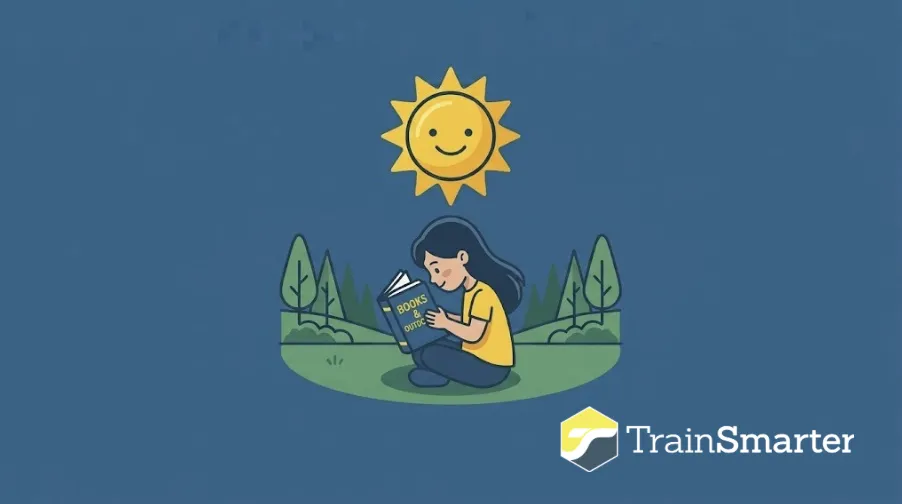
The Surprisingly Simple Reason Nearsightedness Is Skyrocketing
One of my defining traits growing up was that I was decidedly not athletic—not even what you might call “active.”
With no other kids in the neighborhood, my sister and I gravitated toward books in the place of playmates — enough that my dad, an elementary school teacher of all people, used to tell us, “You’ve always got your nose stuck in a book!”
In fourth grade, I told my teacher I couldn’t see the map on the wall. I still remember her kneeling next to me and telling me that she could see it just fine — as if she didn’t quite believe me. That was the year I was diagnosed with myopia (nearsightedness) and started wearing glasses. My sister’s diagnosis followed soon after.
Given all that, a recent wave of research on myopia caught my attention.
Myopia is becoming a public health concern. Diagnoses have increased by more than 25% over the past 40 years. By 2050, close to half the world’s population is projected to be nearsighted!
Take Japan, for instance.
The rate of childhood nearsightedness in Japan ranks among the highest in the world, with over 80% of 14-year-olds affected. Researchers attribute this surge to a perfect storm of modern lifestyle changes: intense academic pressure driving longer hours of close-up desk work, combined with much less time spent playing outdoors in the sunlight.
Researchers have determined one particular factor: kids aren’t outside as much as they used to be. One survey found only about 27% of children play outside regularly today, compared to roughly 80% of adolescents two generations ago!
Instead, they’re spending time indoors, playing video games, and scrolling on screens.
Myopia happens when the eyeball elongates, making distant objects blurry while close-up vision stays sharp. That elongation is permanent. Glasses and contact lenses correct the result, not the cause.
That “shape shift” has further implications. Elongated eyes are at higher risk for glaucoma, early cataracts, macular degeneration, and retinal tears or detachment down the road.
Being outside is important in numerous ways.
Playing outside and being in the sun improves everyone’s eye health, but it’s especially important for children.
Bright light outdoors triggers the release of dopamine in the eye and brain. Dopamine is a neurotransmitter that helps regulate how the eyeball grows and keeps its shape.
Sunlight also boosts vitamin D, which appears to strengthen the outer structure of the eye and reduce inflammation, both of which help prevent the kind of stretching that leads to myopia.
Screen time, or any extended close-up focus (it doesn’t have to be screen time, but it’s the most common close-up activity—most young people aren’t needlepointing…), can cause the eye to elongate as it tries to reduce the effort of focusing up close.
This effect is strongest in young, still-developing eyes, and a major reason that the World Health Organization recommends no screen time at all under age two, and no more than an hour a day between ages two and five.
Prevention is simple. Get outside!
A recent report recommends consistent outdoor time throughout childhood.
About an hour a day outdoors is associated with a 45% reduction in myopia risk. Bumping it up a little more to roughly 76 minutes a day pushes that closer to 50%.
Anyone doing a lot of close-up work (screens, reading) should practice the old “20-20-20” rule I learned in an office ergonomics course: every 20 minutes, look at something 20 feet away for 20 seconds.
There’s a flip side….
Ironically, despite my childhood history of indoor reading, I ended up having a career that required primarily distance vision — leading group fitness classes, watching people move, and correcting form from across a room. Through my 40s, as everyone around me (especially the avid readers in the bunch) started reaching for reading glasses, I was fine.
Then the pandemic hit, and I spent innumerable hours coaching clients via staring at an iPad. Not long after, I needed reading glasses myself — in my 60s, later than most, but it caught up with me, too.
I can’t say for certain how much of that delay came down to a career spent looking at things far away rather than up close. But I’m convinced that however old you are, however good or bad your eyes may be, it’s worthwhile to take a few minutes to step outside and look at something far away — tree branches high in the air, the sky, the end of the block.
Your eyes are designed to look at more than just what’s twelve inches in front of your face.
